
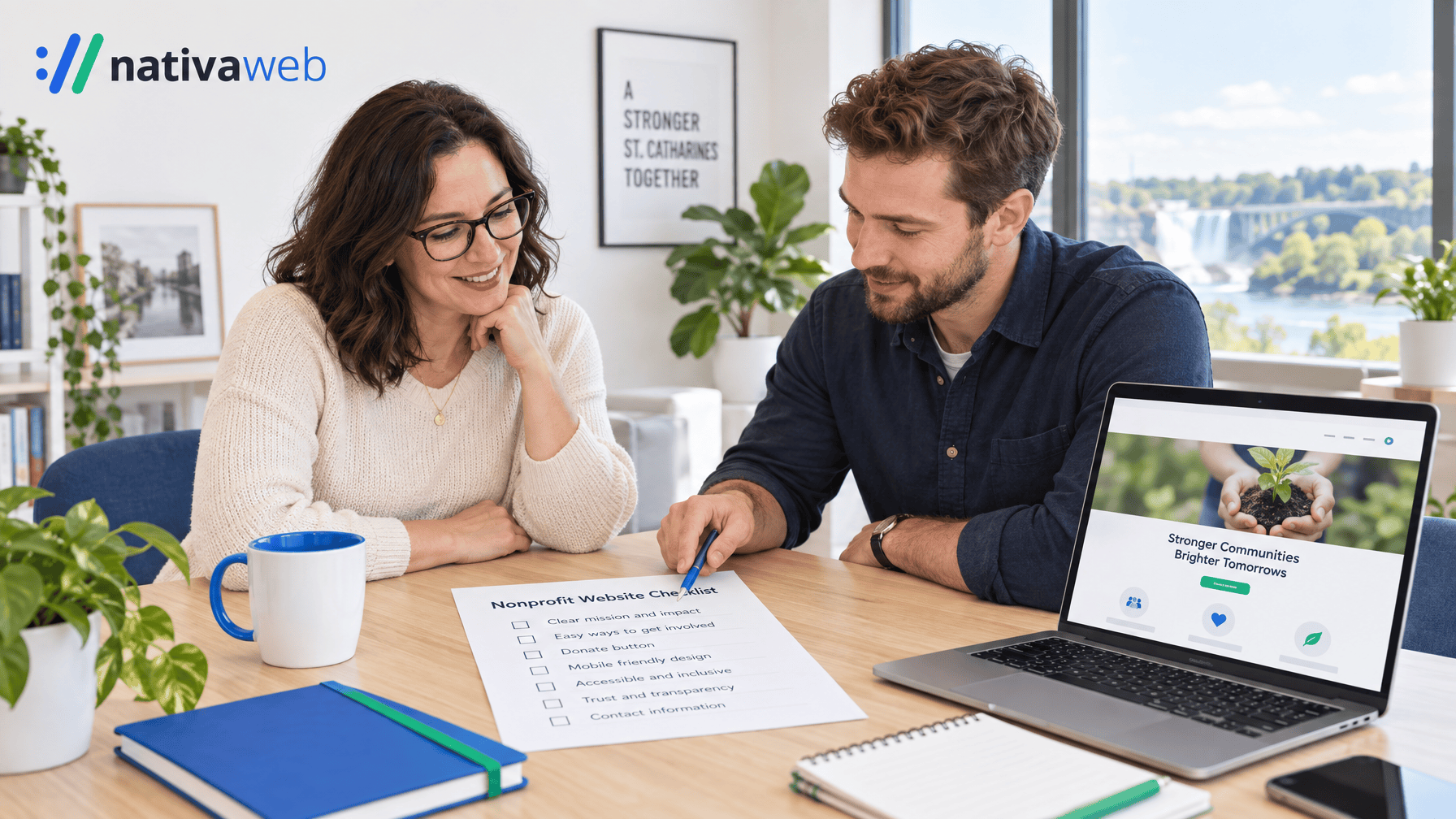
A board in St. Catharines can spend six months comparing portfolios and still hire a shop that keeps the domain in their own name. Pretty screenshots do not tell you who owns the files, who trains staff, or how the donate form works with a keyboard.
This is a hiring checklist for Ontario nonprofits and community groups. Clinics can use the same questions for hours and booking. It sits beside our notes on how to choose a web agency in Canada and what Ontario nonprofits need from WordPress in 2026.
Who this is for
You run programs, not a software company. You need a public site that names the mission, takes a gift or a volunteer form, and stays current when staff change.
Ask these questions when:
- A volunteer built the last site and nobody has the password
- An offshore quote looks cheap until you count training and hosting
- The board wants Canadian hosting or a named contact in Niagara
- You already know you need nonprofit website design Ontario work, not a template with a logo dropped on it
If you already have a partner who answers these in writing, skip to the maintenance questions.
Who owns the domain, hosting, and admin
Put this in the first email, not the last invoice.
Ask:
- Whose name is on the domain registrar after launch?
- Whose credit card pays for hosting, and can we move the site without a ransom?
- Who holds the WordPress administrator account?
- Where do backups live, and how do we restore on a Tuesday?
A Canadian web design agency that works with charities should leave the organization as owner. You should be able to change partners without rebuilding from scratch.
If they say “we keep admin so nothing breaks,” that is a lock-in, not a service.
How they treat accessibility (not a widget)
Ontario’s page on how to make websites accessible is clear: the organization that controls the site (directly or through a contractor) must meet the rules. As of January 1, 2021, designated public sector organizations and businesses or non-profits with 50 or more employees must make public websites and content posted after January 1, 2012 meet WCAG 2.0 Level AA, with two media exceptions (live captions and pre-recorded audio descriptions). Smaller charities still have donors and volunteers who cannot use a mouse. A practical build target is WCAG 2.1 Level AA.
Ontario even lists questions to ask a developer:
- Are you familiar with WCAG 2.0 Level A and AA?
- Have you shipped an accessible site, with links you can check?
- Do you test with automated tools, manual checks, and assistive technology such as a screen reader?
Add your own:
- Can I tab through Donate and Volunteer without getting stuck?
- Do buttons say “Donate $25,” not “Submit”?
- Is contrast on the Give button strong enough, or only pretty?
An overlay plugin is not a plan. Labels and headings live in the theme and the copy. Our AODA and WCAG guide walks through the same checks.
Who publishes after launch
WordPress roles exist so the coordinator can post Friday’s food drive without an Administrator login.
Ask:
- Which role will staff use (Editor, not five Super Admins)?
- Who trains two people, on a phone, for thirty minutes?
- What happens when someone leaves: disable the user, or rebuild?
If the agency is the only one who can add a snow-day closure, you hired a bottleneck. Staff should publish. The partner should keep the platform healthy.
What the homepage actually has to do
Google’s SEO starter guide is enough for most boards: honest titles, useful headings, pages that answer the query.
Ask the agency to show, on a phone:
- Who you help and where (St. Catharines, Welland, Niagara Falls), in the first screen
- One primary action (Donate or Volunteer), not four buttons at the same volume
- Hours and a tap-to-call number that match Google Business Profile
- Program pages that name the town and the next date, not a slogan that could live in any city
If they lead with “empowering communities” and never name the food bank, keep looking.
Forms, receipts, and privacy
Donors bounce when a form asks for a life story.
Ask:
- Which fields are required, and why?
- Where do error messages sit (next to the field, in plain words)?
- Who issues tax receipts, and does that tool look like your organization?
- Where is personal information stored, and who can see it?
The Office of the Privacy Commissioner of Canada’s guidelines for processing personal data across borders note that PIPEDA does not ban transfers to another country, but you remain responsible for the information. If the board wants Canadian hosting, say so in the brief. If you send newsletters, read Canada’s anti-spam rules before anyone promises a weekly blast.
Scope, money, and what “done” means
A cheap homepage with no training is not cheap.
Get in writing:
- Pages in scope, and what a new program page costs later
- Content: who writes, who supplies photos, who writes alt text
- Timeline with real dates, not “Q4”
- Support after launch: hours, response time, what is included vs. billed
- How they handle a broken donate form on a Saturday
Ask for two live charity or clinic sites, not only Dribbble shots. Call those clients if you can.
NativaWeb is a St. Catharines digital agency. We build WordPress sites for Niagara and Ontario nonprofits with this split: staff publish, we keep the platform healthy, accessibility lives in the theme.
A one-page scorecard you can print
Score each shop 0 (no answer), 1 (vague), or 2 (in writing):
- Domain, hosting, and admin in the organization’s name
- WCAG testing method, not an overlay
- Editor role and a training date
- Donate and volunteer on mobile, keyboard-tested
- NAP (name, address, phone) matches Maps
- Hosting location named
- Post-launch support named in hours and dollars
Twelve or more is a conversation. Under eight is a brochure.
Book a free look at the answers
Bring the current site, the domain login if you have it, and the three questions that worry the board most.
Book a free consultation at nativaweb.com. We will tell you what to fix this week and what can wait.