
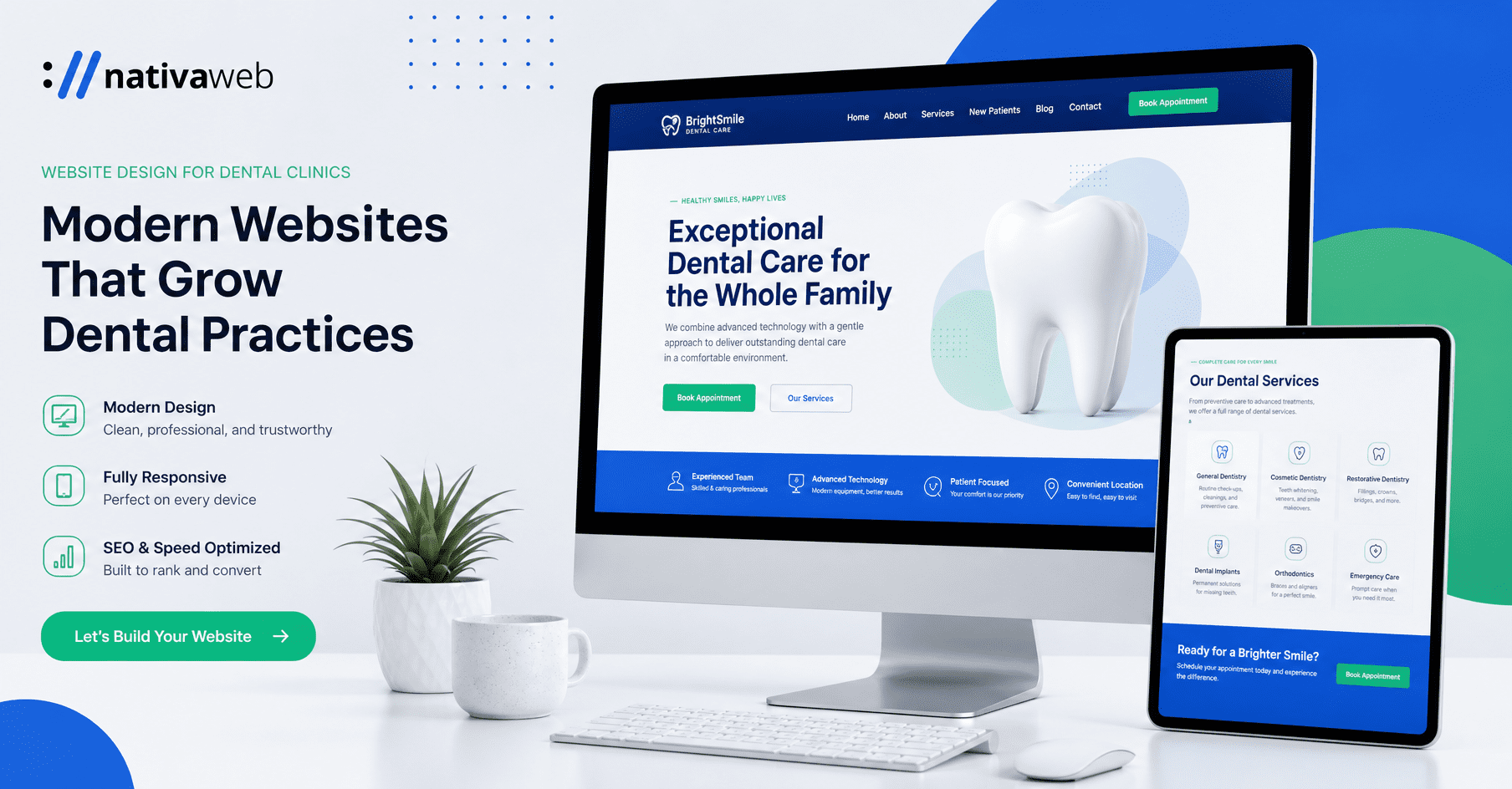
When a potential patient needs a dentist, their first move is a Google search. And when they land on your website, they decide within seconds whether your practice feels trustworthy enough to book an appointment. In Canada's competitive dental market, a well-designed website is not optional — it is part of your clinical reputation.
This guide walks through the most important elements of effective dental clinic website design in Canada, so you can make informed decisions whether you're building from scratch, redesigning, or evaluating your current site.
1. First Impressions Happen in Under Three Seconds
Research consistently shows that visitors form an opinion about a website in roughly 50 milliseconds. For a dental clinic, that snap judgment carries weight. Patients are trusting you with their health, and a cluttered, dated, or confusing website signals the opposite of the clean, professional experience they expect in your chair.
What a strong first impression requires:
- A clear headline that tells visitors what you do and where you are (e.g., "Family Dentistry in St. Catharines, ON")
- A prominent, easy-to-find booking button — ideally in the top navigation and above the fold on mobile
- Professional photography of your actual clinic and team, not generic stock images
- A clean layout with generous white space and readable fonts
Patients should never have to hunt for your phone number or your "Book an Appointment" link. If they do, they'll leave.
2. Mobile-First Is Non-Negotiable
More than 60% of local searches happen on a smartphone. If your dental website is not optimized for mobile — meaning it loads fast, adjusts to any screen size, and lets patients book with their thumbs — you are losing appointments every single day.
Mobile-first design means:
- Touch-friendly buttons and menus (nothing too small to tap)
- Text that is readable without zooming
- Click-to-call phone numbers
- A booking flow that works smoothly on a 5-inch screen
- Page load times under three seconds on a mobile connection
Google also uses mobile performance as a ranking factor, so a slow or broken mobile experience hurts your search visibility on top of frustrating patients.
3. Online Booking Is the Standard, Not a Bonus
Canadian patients increasingly expect to book appointments online, at any hour. If your only option is a phone call during office hours, you are leaving bookings on the table — especially for younger patients who prefer not to make calls.
A good dental website integrates a booking system directly into the site. This could be a simple contact form with appointment request fields, or a full integration with your practice management software (Dentrix, Tracker, Curve Dental, etc.). Either way, the booking experience should be simple, take under two minutes, and send a confirmation automatically.
4. Local SEO: How Patients in Your City Find You
Ranking on Google for searches like "dentist near me" or "dental clinic [your city]" is one of the highest-value marketing activities a dental practice can do. Most patients pick a dentist within a short drive, so local search visibility directly translates to new bookings.
The key local SEO elements for a dental website include:
- Your city and province on every page — in headings, body text, and metadata
- A Google Business Profile that is complete, accurate, and collecting reviews
- Consistent NAP (Name, Address, Phone) across your website and all directories
- Location-specific service pages if you serve multiple communities
- Patient reviews embedded or linked on your site — trust signals matter for both Google and potential patients
Dental clinic website design in Canada should always account for local SEO from the ground up, not as an afterthought.
5. Accessibility and WCAG Compliance
This one surprises many clinic owners: in Canada, website accessibility is not just a best practice — it is increasingly a legal requirement. The Accessibility for Ontarians with Disabilities Act (AODA) requires organizations in Ontario to meet Web Content Accessibility Guidelines (WCAG) 2.0 Level AA standards.
For a dental clinic, this means your site should be usable by patients with visual, auditory, or motor impairments. Practical steps include:
- Sufficient color contrast between text and backgrounds
- Alt text on all images
- Keyboard navigability (users who cannot use a mouse can still move through the site)
- Captions on any video content
- Clear, descriptive link text (not just "click here")
Beyond compliance, an accessible website simply works better for everyone — including older patients who may find small text or low-contrast design difficult to read.
6. Trust Signals That Convert Visitors Into Patients
A dental website's job is to build enough trust that a stranger becomes willing to let you work on their teeth. That is a high bar. Your site should include:
- Team bios with real photos — patients want to know who they'll be seeing
- Patient testimonials and Google review highlights
- Certifications, associations, and credentials (Royal College of Dental Surgeons of Ontario, etc.)
- Before-and-after galleries for cosmetic services
- A clear explanation of your services in plain language, not dental jargon
- Insurance and payment information — billing confusion is a common reason patients don't book
Transparency builds confidence. The more clearly your website communicates what to expect, the easier it is for a new patient to take that first step.
7. Speed, Security, and Reliable Hosting
A slow website loses patients and rankings. A hacked website loses everything. Dental clinics handle sensitive patient data, which means your hosting environment and security standards matter.
Your website should:
- Load in under three seconds on desktop and mobile
- Use HTTPS (SSL certificate) — this is a baseline expectation and a Google ranking factor
- Be hosted on a reliable Canadian or North American server
- Have regular automated backups
- Have a security monitoring plan in place
For Canadian clinics specifically, hosting patient inquiry data on Canadian servers is a consideration worth discussing with your web agency in the context of PIPEDA compliance.
Getting It Right From the Start
A dental clinic website is a long-term investment. Done well, it works for your practice around the clock — answering questions, building trust, and filling your appointment calendar without you lifting a finger.
The mistake many clinics make is treating the website as a one-time project rather than a living part of their practice. Content should be updated, performance should be monitored, and the site should evolve as your services grow.
Working with a web agency that understands the specific needs of healthcare providers — patient trust, accessibility compliance, local SEO, and booking UX — makes all the difference.
Ready to give your dental clinic the website it deserves?
NativaWeb specializes in dental clinic website design for Canadian practices. We combine clean, professional design with local SEO, accessibility compliance, and ongoing support so your site works as hard as you do.
Book a free, no-pressure consultation at nativaweb.com — we'd love to learn about your practice and show you what's possible.